Board Games I Love
I admit it, I’m a board game fanatic. Luckily I have a great group of friends who also love playing board games and we get together 1-2 nights a month to play. I own a lot of games myself, and though there is some duplication in collections (Many of us own Settlers of Catan for ourselves, along with Dominion and Carcassonne) I’d say that between all of us we have at least 500 unique games / add ons to games / variants of games. That’s a LOT of choices - though some get played very rarely (I’m looking at you Risk and Axis and Allies). Board games are my favourite choice for a night out with friends since it’s social without being in a loud restaurant or at a movie and I don’t have to have pre-read a book like at book club. I’m going to list my current 5 favourite games - though the list changes frequently as I discover new games or rediscover games I had forgotten about - with a bit of a description of the game and my thoughts on playability.
5) Tsuro
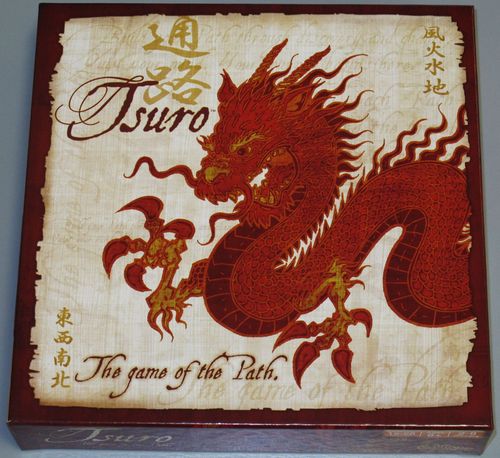
I was only introduced to this wonderful game recently, and while I don’t own it, it’s definitely on my list! The game is really quick (averaging 15-20 minutes) and a great “appetizer” in front of longer games or one to play while waiting on people to show up. The premise is simple -each player has a token and a tile in front of them. You create the board as you go along, with each person playing one tile per turn. Your token moves along the path you are creating. The goal of the game is to be the last one still on the board - tiles can move you off the board, at which point you are out. As the game progresses, your token may be affected by other players who want to knock your token off the board. The game is gorgeous to look at and elegant in its simplicity. It can have anywhere between 2-8 players and the recommended age is 8 years and up. I highly recommend it.
4) Ticket To Ride
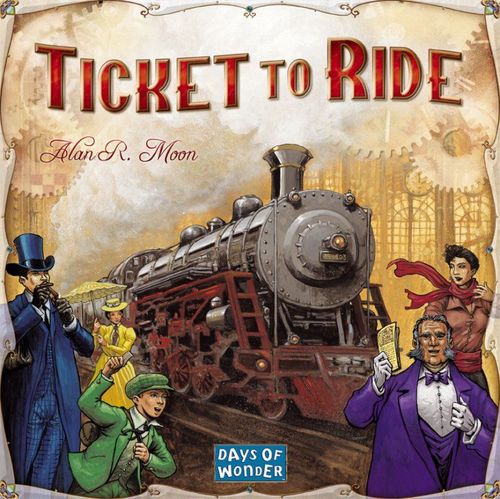
I was introduced to Ticket to Ride by friends soon after the European map came out in 2005. It was a lot of fun to play and I really liked that it was a strategy game that could be learned in about 15 minutes and played in 30-45 minutes. While several of my friends prefer the European map because it has stations that allow you to connect your trains through cities that would otherwise be inaccessible because others have played there, I love the North American map because it doesn’t have stations. You really need to plan your strategy. The object of the game is to collect and play matching train cards to claim railway routes between cities. Trains of differing lengths have different point values. You can also score points by finishing destination tickets (connecting 2 distant cities by trains), and there are bonus points for longest route. The game play is very simple with only 3 possible actions each turn (drawing train cards, playing a set of train cards to claim a route, or drawing more destination tickets) so the game pace is very quick. Ticket to Ride is for 2-5 players ages 8 and up. It’s lots of fun and is considered a “gateway” game to introduce people to tabletop gaming.
3) Qwirkle
Qwirkle falls into the category of what I would describe as deceptively tricky games. The premise is really simple: match tiles either by colour or by shape. There are 108 tiles total - 3 sets of 6 different shapes in 6 different colours. The catch is that you must play your tiles in a line and that the lines cannot contain duplicates and must contain a tile that matches either the shape or colour of the line you are joining. You get a point for each tile in the line(s) that you play, and a bonus of 6 points for completing a set of 6. The tricky part comes in the strategy - do you play your tile knowing that your opponents may be able to finish the line of 6? Do you wait and hope you draw the needed tile? Will someone else block the space you need? It can be really hard to pre-plan moves because the board changes with each player’s turn. Qwirkle is for 2-4 players aged 6 and up. I’ve played it with both kids and adults and everyone enjoys this game - especially since it takes between 30-45 minutes for a game.
2) 7 Wonders
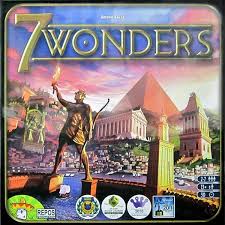
This game isn’t considered to be an introductory game, though there’s no real reason it couldn’t be. It’s fairly complex but once you’ve played it through, it has a high replay value. 7 Wonders is essentially a card development game - you build cards to either help you now or help you later. The game has 3 stages and each stage has different cards in it (and they tend to go up in cost as well as point value). The object is to have the most points and there are tons of different ways to gain points. You have a deck of cards to begin the stage and then choose one card to build immediately and pass the rest on to your neighbour (on left or right depending on the stage). You can also bury your card to build a part of your wonder (which usually gives points at the end of the game). That’s where the strategy comes in - which card do you build / bury knowing that all the rest are going to your opponent. (Cards move around after every turn and you display what you built immediately so you know approximately how you are doing in relation to the other players). It is very possible to overthink the game or try too many strategies and fail at all of them. It’s also possible to have no real strategy at the beginning and still win. I’ve done both. 7 Wonders takes between 10 and 15 minutes to set up and between 30-45 minutes to play depending on how long each person takes to decide what they are doing each turn. You can play with 2-7 players (I’ve never tried 2 player) and the recommended ages are 10 and up. If you take the time to learn to play, it’s a great game to pull out with friends.
1) Bananagrams

I’m a word geek. I loved scrabble but finding people to play against me was always hard. I also didn’t like having to have a board and the restrictions the board imposed on gameplay or having to wait for the other players to play before I could enter my next word. Enter Bananagrams. In Bananagrams, each player works independently to create a crossword grid of words using letters from their own pile. Everyone starts with the same number of letters, and when one person has used up all their letters, each player picks up an additional tile from the joint pool. When there are no tiles left to pick up, the person who uses all their tiles first is the winner. It seems easy but you only have your own words to build off of, and there are no letter values so being stuck with a Q and no U or a Z just makes it harder to play instead of giving you extra points. That said, it’s a fantastic mental challenge and lots of fun for 1-8 players to play at the same time. A game can last as short as 10 minutes depending on the speed at which players can use their letters. The game is best for ages 7 and up as you do need to be able to spell enough words to make use of the tiles. It’s a fun and very portable game that can be played pretty much anywhere.
So those are my 5 favourite games right now. Tell me in the comments what games your family enjoys!